From the brand's Inside HorseFil panel
HorseFil Ingredients: The Six Named Ingredients Explained
HorseFil names six ingredients: L-Citrulline, L-Carnitine, Panax Ginseng, Maca Root, Rhodiola and Grape Seed Extract. The amount of each is not published. Research used grams of citrulline (3 to 6 g) and carnitine (1 to 4 g) a day, so one small gummy very likely holds far less. Check your jar's Supplement Facts panel.
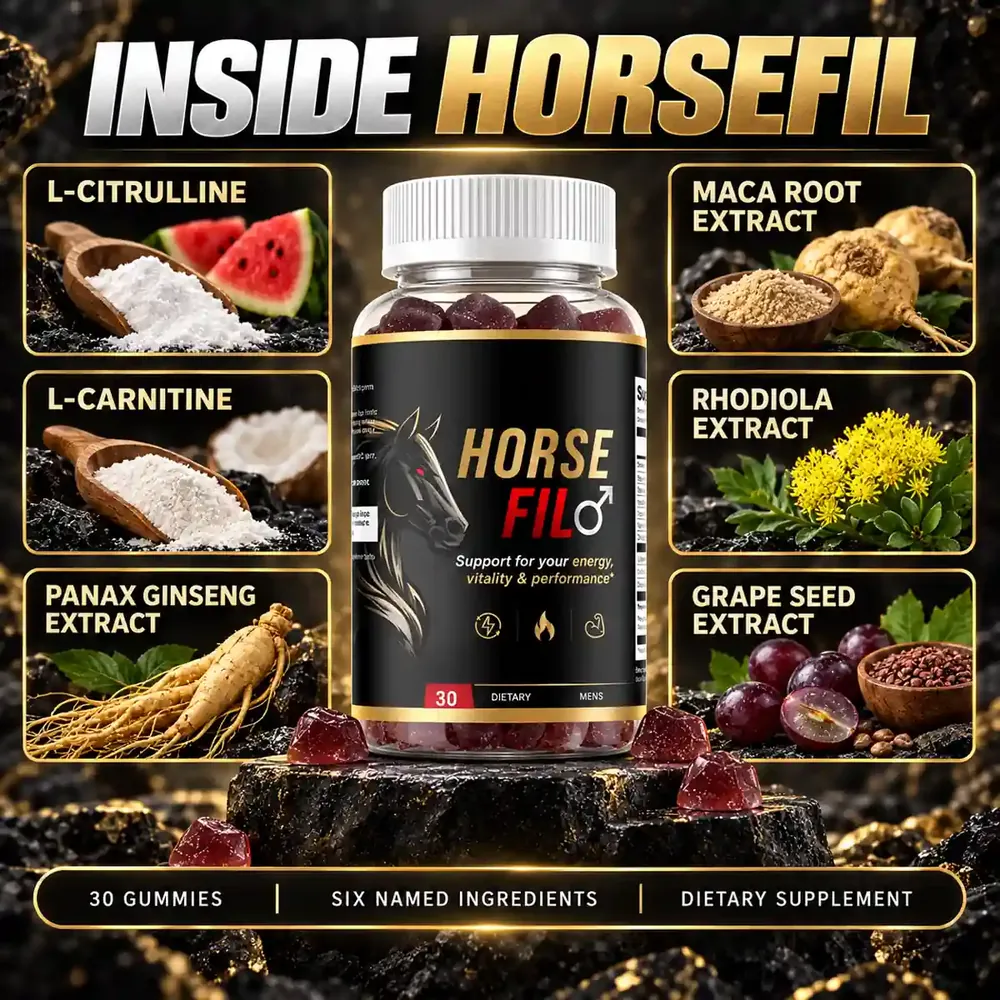
What ingredients are in HorseFil?
The brand's ingredients panel names six: L-Citrulline, L-Carnitine, Panax Ginseng Extract, Maca Root Extract, Rhodiola Extract and Grape Seed Extract. The amount of each one is not published. The panel is headed "INSIDE HORSEFIL" and reads "30 GUMMIES | SIX NAMED INGREDIENTS | DIETARY SUPPLEMENT".
That panel is a marketing image, not the legal label. We did not get the Supplement Facts panel, and it is not readable on the jar photos we have. So we can tell you what each ingredient is and what research has looked at. We cannot tell you how much of it sits in a gummy.
| Ingredient | What it is | Amounts used in research | Amount per HorseFil serving |
|---|---|---|---|
| L-Citrulline | Amino acid, found in watermelon | About 3 to 6 g a day, or about 8 g citrulline malate | Not published |
| L-Carnitine | Compound the body makes; also in meat | 1 to 4 g a day in studies of clinical benefit | Not published |
| Panax Ginseng Extract | Root of Asian ginseng | Varies by study; research is mixed | Not published |
| Maca Root Extract | Andean root vegetable | About 1.5 to 3 g of dried maca a day | Not published |
| Rhodiola Extract | Cold-climate plant root | Varies; trials small and of mixed quality | Not published |
| Grape Seed Extract | Extract from grape seeds | Low hundreds of mg up to 2,000 mg a day | Not published |
Two amino acids lead the list. Two root extracts follow. Then come a plant extract and a seed extract. Below, each one gets its own short profile.
The six named ingredients, one by one
Each profile covers three things: what the ingredient is, what research has looked at, and how the studied amount compares with what we know about HorseFil. The last part is short for every ingredient, because the amount is not published.
1. L-Citrulline
L-citrulline is an amino acid. Watermelon is a well-known food source. The body turns it into L-arginine, which it then uses to make nitric oxide.
Most human research on it is about exercise. A 2020 review found those studies commonly used about 3 to 6 g of L-citrulline a day, or about 8 g of citrulline malate (Gonzalez & Trexler, 2020). Results across the studies were not all the same.
In HorseFil: amount not published. Research used grams, not milligrams.
2. L-Carnitine
L-carnitine is a compound your body makes on its own. It helps move fats into cells, where they can be used for energy. Red meat and dairy also supply it.
The NIH Office of Dietary Supplements says studies of clinical benefit typically used 1 to 4 g a day. It also says results for exercise are mixed (NIH ODS, 2023).
In HorseFil: amount not published. Like citrulline, research amounts are in grams.
3. Panax Ginseng Extract
Panax ginseng is also called Asian ginseng. The root has a long history in traditional Chinese and Korean practice. An extract is a concentrated form of the root.
NCCIH describes the research as mixed. Ginseng may modestly help with fatigue. It does not appear to help with sport or exercise results (NCCIH, 2025). Short-term use of up to 6 months appears safe for most people.
In HorseFil: amount and extract strength not published.
4. Maca Root Extract
Maca is a root vegetable. It grows high in the Andes of Peru, where people have eaten it as food for a long time.
A 2012 review of maca looked at its traditional use and the human studies so far. It noted that those studies commonly used about 1.5 to 3 g of dried maca a day (Gonzales, 2012).
In HorseFil: amount not published. An extract can be stronger than dried root, so the label would need to say which form and how much.
5. Rhodiola Extract
Rhodiola rosea is a plant that grows in cold places. It has a history in Scandinavian and Russian herbal practice.
NCCIH says there is not enough reliable evidence to show rhodiola helps with any health purpose (NCCIH, 2025). A systematic review found the trials were of mixed quality (Hung et al., 2011). NCCIH lists it as possibly safe for up to 12 weeks.
In HorseFil: amount not published.
6. Grape Seed Extract
Grape seed extract is made from the seeds of wine grapes. It is rich in plant compounds called proanthocyanidins.
A 2016 meta-analysis pooled 16 trials on blood pressure. Those trials used amounts from the low hundreds of milligrams up to 2,000 mg a day (Zhang et al., 2016). NCCIH says it is generally well tolerated (NCCIH).
In HorseFil: amount not published.
Could one gummy hold research-level amounts?
For L-citrulline and L-carnitine, it is very unlikely. Research used 3 to 6 g of citrulline and 1 to 4 g of carnitine a day, and a single gummy is small and mostly gummy base.
A gummy has to hold sugar or sweetener, a gelling agent, flavor and color. That leaves limited room for active ingredients. Six of them share whatever room is left. We cannot confirm the real amounts without the label panel, so treat this as a reasoned estimate, not a finding.
Our page on how HorseFil works explains what that means for what you can expect.
What to check on your own jar label
Your jar should carry a Supplement Facts panel. It answers most of the open questions on this page in under a minute.
| Question to ask | Where to find the answer |
|---|---|
| How much of each ingredient is in one serving? | The Supplement Facts panel on your jar |
| Is the amount listed alone, or as a blend total? | Look for the words proprietary blend or a single total weight |
| What is the serving size? | Top line of the Supplement Facts panel |
| What makes up the gummy itself? | The Other Ingredients line under the panel |
| Which extract form is used? | Extract ratios or standardization notes, if printed |
If the panel lists a "proprietary blend", you will see one total weight for several ingredients. You will not see how that total splits. That is legal, but it tells you less.
Our step-by-step guide on how to read a men's supplement label walks through each line.
Are any of the six a concern with medicine?
Some of them can be. If you take any prescription medicine, talk to your doctor before you start HorseFil.
The side effects page covers what each ingredient can cause and when to stop.
How the six ingredients group together
They fall into three loose groups. Seeing them this way makes the list easier to follow.
Amino acids
L-Citrulline and L-Carnitine. Both are made in the body and found in food. Both are studied at gram doses.
Root and plant extracts
Panax ginseng, maca and rhodiola. Traditional plants with mixed or thin research.
Seed extract
Grape seed extract. Studied for blood pressure at a wide range of amounts.
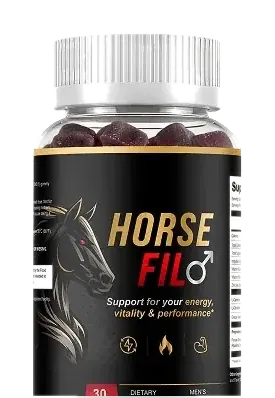
None of these groups adds up to a promise. The label line on the jar reads "Support for your energy, vitality & performance*". The asterisk points to the FDA statement: these claims have not been evaluated by the FDA. For what the brand says the gummies are made for, see HorseFil benefits.
HorseFil ingredients: common questions
How many ingredients does HorseFil have?
The brand's ingredients panel names six. The full label may also list other ingredients that make up the gummy, such as a sweetener, gelling agent and color. Those were not published.
How much L-citrulline is in HorseFil?
The amount is not published. Studies used about 3 to 6 g a day. A small gummy very likely holds much less, but only your jar's Supplement Facts panel can confirm it.
Is HorseFil gelatin or pectin based?
We do not know. The other ingredients line was not supplied, so the gummy base is not published. Check the label if this matters to you.
Is there caffeine in HorseFil?
Caffeine is not among the six named ingredients. The full label was not supplied, so read the jar to be sure.
Why does the order of ingredients matter?
On a Supplement Facts panel, blend ingredients are usually listed from most to least by weight. The brand panel's order may not follow that rule, so do not read amounts into it.
Does the Doctor Formulated seal tell me anything about the ingredients?
Not much. No doctor is named in anything we were given, so we cannot verify that seal.
Sources for this page
- Gonzalez AM, Trexler ET. Effects of citrulline supplementation on exercise performance in humans: a review of the current literature. J Strength Cond Res, 2020. Source
- NIH Office of Dietary Supplements. Carnitine: Fact Sheet for Health Professionals. Updated 2023. Source
- National Center for Complementary and Integrative Health. Asian Ginseng. Updated February 2025. Source
- Gonzales GF. Ethnobiology and ethnopharmacology of Lepidium meyenii (Maca), a plant from the Peruvian highlands. Evid Based Complement Alternat Med, 2012. Source
- National Center for Complementary and Integrative Health. Rhodiola. Updated April 2025. Source
- Hung SK, Perry R, Ernst E. The effectiveness and efficacy of Rhodiola rosea L.: a systematic review of randomized clinical trials. Phytomedicine, 2011. Source
- Zhang H, et al. The impact of grape seed extract treatment on blood pressure changes: a meta-analysis of 16 randomized controlled trials. Medicine (Baltimore), 2016. Source
- National Center for Complementary and Integrative Health. Grape Seed Extract. Updated February 2025. Source
Keep reading
Ready when you are
Order HorseFil from the authorized US retailer
30 servings in every 2 fl oz bottle. 60-day money-back guarantee. A real person at +1 (302) 200-3480 for orders, tracking and refunds.