Research notes
HorseFil's Six Named Ingredients: What the Research Tested
Research tested L-citrulline at about 3 to 6 g a day and L-carnitine at 1 to 4 g a day. Maca studies used 1.5 to 3 g of dried root, and grape seed trials used up to 2,000 mg. Ginseng evidence is mixed and rhodiola evidence is weak. HorseFil's amounts are not published.
What did research test for HorseFil's six ingredients?
Research tested each of HorseFil's six named ingredients at known amounts, and HorseFil's own amounts are not published. So we can describe the studies, but we cannot say how close a gummy comes to them.
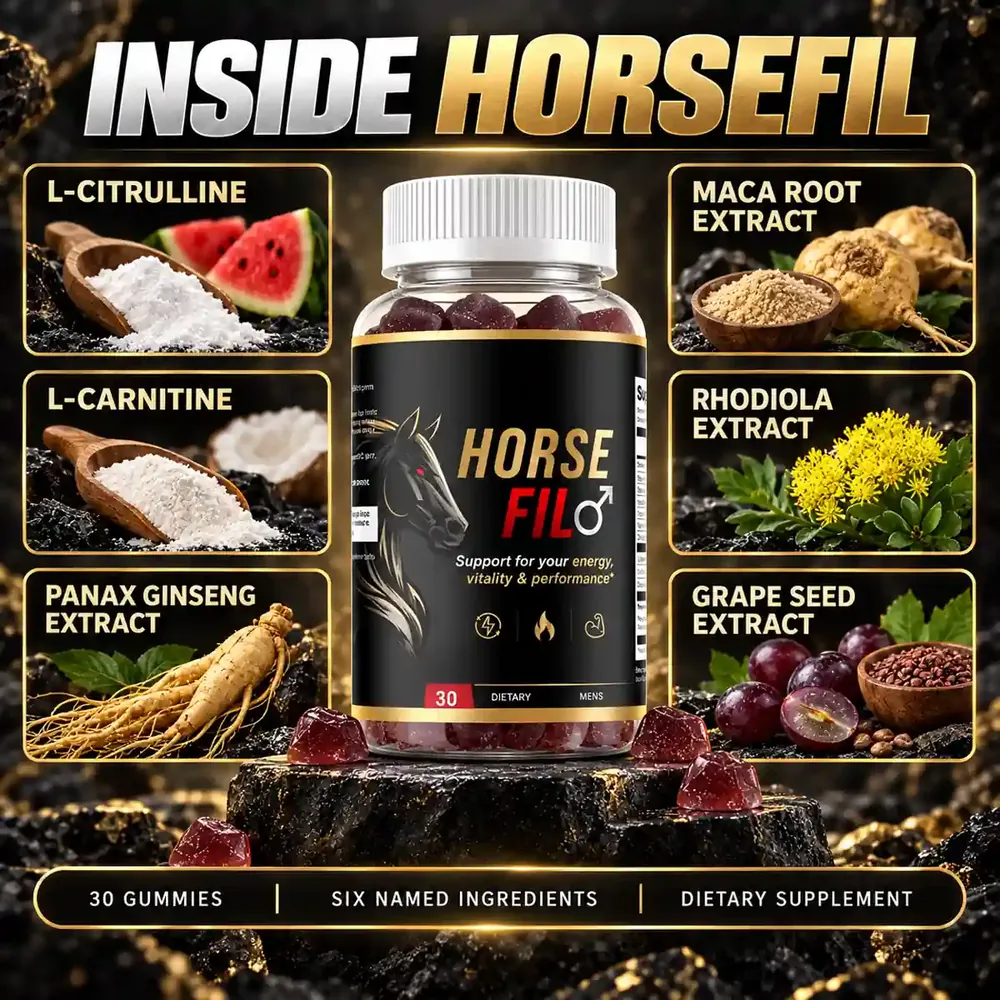
The brand's ingredients panel names L-Citrulline, L-Carnitine, Panax Ginseng Extract, Maca Root Extract, Rhodiola Extract and Grape Seed Extract, in that order. No Supplement Facts panel was supplied to us. For each ingredient below, we cover four things.
- What the cited source says, in plain words.
- Who was studied, as far as the source tells us.
- What amount was used, in grams or milligrams.
- The gap between that amount and HorseFil's unpublished one.
We only cite sources we read and link. Federal pages from NCCIH and the NIH Office of Dietary Supplements lead where they exist. For plain notes on each ingredient, see our HorseFil ingredients page.
What amounts did the studies use?
The studies used amounts from a few hundred milligrams to several grams a day. The table sets each ingredient beside its studied use, amount and source.
| Ingredient | Studied use | Studied amount | Source |
|---|---|---|---|
| L-Citrulline | Exercise | About 3 to 6 g a day, or about 8 g citrulline malate | Gonzalez and Trexler, 2020 |
| L-Carnitine | Clinical benefit; exercise results mixed | 1 to 4 g a day | NIH ODS |
| Panax Ginseng Extract | Fatigue and general use; mixed research | No single amount in the summary we cite | NCCIH, 2025 |
| Maca Root Extract | Human studies of dried maca | About 1.5 to 3 g of dried maca a day | Gonzales, 2012 |
| Rhodiola Extract | Several uses; not enough reliable evidence | No single amount in the summary we cite | NCCIH, 2025 |
| Grape Seed Extract | Blood pressure trials | Low hundreds of mg up to 2,000 mg a day | Zhang et al., 2016 |
Two rows stand out. Citrulline and carnitine were both studied in grams. That is where the size of a gummy matters most. Our gummies vs. capsules post explains why a gummy holds less active material than a capsule or a powder scoop.
L-Citrulline: what did the research test?
Research tested L-citrulline in human exercise trials, at about 3 to 6 g a day. A review by Gonzalez and Trexler, 2020 also found studies that used about 8 g of citrulline malate, a form that pairs citrulline with malic acid.
Who and how much
The review looked at human exercise trials. Results varied from study to study. The body turns citrulline into arginine, which it uses to make nitric oxide. That is the reason researchers study it with exercise.
The gap
Three grams is 3,000 mg. It is very unlikely that one HorseFil gummy carries that much, since most of a gummy is base. We cannot confirm this without the label panel.
L-Carnitine: what did the research test?
Research on L-carnitine used 1 to 4 g a day in studies of clinical benefit. The NIH Office of Dietary Supplements says exercise results are mixed.
Who and how much
The body makes carnitine, and meat supplies more. It helps move fats into cells to be used for energy. Most healthy adults make enough on their own, which is one reason supplement results in healthy people are hard to show.
The gap
Like citrulline, carnitine is measured in grams. A single gummy is very unlikely to hold 1 to 4 g. We cannot confirm the amount without the panel.
Panax Ginseng: what did the research test?
Research on Panax (Asian) ginseng is mixed, and it may modestly help fatigue. The NCCIH summary from February 2025 also says it does not appear to help athletes do better in sports.
Who and how much
Studies have looked at many uses in adults. The NCCIH summary does not set one standard amount, so we do not list one. It says short-term use of up to 6 months appears safe for most people.
The gap
Ginseng is an extract, and extracts vary in strength by how they are made. Without a printed amount and extract strength, a HorseFil gummy cannot be matched to any study.
Maca Root: what did the research test?
Human studies of maca commonly used about 1.5 to 3 g of dried maca a day. That is the range in a review by Gonzales, 2012.
Who and how much
Maca is a root vegetable from the Peruvian Andes. People there eat it as food. The review covers its traditional use and the human studies done so far. NIH LiverTox keeps a page on maca.
The gap
HorseFil lists Maca Root Extract. An extract can be stronger per gram than dried root, but the ratio is not published. So the dried root range does not map straight onto the gummy.
Rhodiola: what did the research test?
Rhodiola has been tested for several uses, but NCCIH says there is not enough reliable evidence that it helps any health purpose. That is the view in the NCCIH summary from April 2025.
Who and how much
A systematic review by Hung, Perry and Ernst, 2011 looked at randomized trials in adults. It found trials of mixed quality. NCCIH says rhodiola is possibly safe for up to 12 weeks. Neither summary we cite sets a standard amount.
The gap
With weak evidence and no set amount, there is no clear target to compare against. HorseFil's rhodiola amount is also not published.
Grape Seed Extract: what did the research test?
Grape seed extract was tested in blood pressure trials at amounts from the low hundreds of milligrams up to 2,000 mg a day. A meta-analysis of 16 randomized trials by Zhang and colleagues, 2016 pooled those results.
Who and how much
The trials enrolled adults and measured blood pressure. NCCIH says grape seed extract is generally well tolerated and advises talking to a health care provider before use.
The gap
Of the six, grape seed has the lowest studied amounts. A gummy has more room for milligrams than grams. Still, HorseFil's amount is not published, so we cannot say where it falls.
What do the sources say about safety?
The sources name a few side effects and interactions worth knowing before you start. Talk to a doctor before use if you take any medicine.
Carnitine at about 3 g a day can cause nausea, cramps, diarrhea and a fishy body odor. It interacts with valproic acid and some other seizure medicines, and with pivalate antibiotics. Ginseng may lower blood sugar and may interact with diabetes medicines and some others; insomnia is its most common side effect. Rhodiola can cause dizziness, headache, insomnia and dry mouth, and has a reported interaction with losartan. Grape seed may add to blood thinners, and citrulline may add to blood pressure medicines, including nitrates.
HorseFil is for healthy adult men 18 and older. Take it as directed on the jar label; the serving size is not published here. See our side effects page for more, and our Supplement Facts page for what the label does and does not show. To check a panel yourself, use our label reading walkthrough.
HorseFil ingredient research: common questions
Does HorseFil contain research-level doses?
We cannot say, because the amounts are not published. For citrulline and carnitine, which were studied in grams, it is very unlikely that one gummy matches the research amount.
Which HorseFil ingredient has the strongest evidence?
None of the six has strong evidence for a men's vitality gummy. Citrulline has exercise studies, ginseng may modestly help fatigue, and rhodiola lacks reliable evidence per NCCIH.
Is maca safe?
Maca is eaten as food in the Peruvian Andes. NIH LiverTox keeps a page on maca. Ask your doctor if you have liver concerns or take medicine.
Why does the ingredient order matter?
On a Supplement Facts panel, blend ingredients are listed from most to least by weight. The brand panel is not a Supplement Facts panel, so its order may not reflect weight.
Where did the six names come from?
From the brand's Inside HorseFil panel. The sales page checked for our brief named no ingredient list, and no Supplement Facts panel was supplied.
Sources for this page
- Gonzalez AM, Trexler ET. Effects of citrulline supplementation on exercise performance in humans: a review of the current literature. J Strength Cond Res, 2020. Source
- NIH Office of Dietary Supplements. Carnitine: Fact Sheet for Health Professionals. Updated 2023. Source
- National Center for Complementary and Integrative Health. Asian Ginseng. Updated February 2025. Source
- Gonzales GF. Ethnobiology and ethnopharmacology of Lepidium meyenii (Maca), a plant from the Peruvian highlands. Evid Based Complement Alternat Med, 2012. Source
- NIH LiverTox. Maca. National Institute of Diabetes and Digestive and Kidney Diseases. Source
- National Center for Complementary and Integrative Health. Rhodiola. Updated April 2025. Source
- Hung SK, Perry R, Ernst E. The effectiveness and efficacy of Rhodiola rosea L.: a systematic review of randomized clinical trials. Phytomedicine, 2011. Source
- Zhang H, et al. The impact of grape seed extract treatment on blood pressure changes: a meta-analysis of 16 randomized controlled trials. Medicine (Baltimore), 2016. Source
- National Center for Complementary and Integrative Health. Grape Seed Extract. Updated February 2025. Source
Keep reading
Ready when you are
Order HorseFil from the authorized US retailer
30 servings in every 2 fl oz bottle. 60-day money-back guarantee. A real person at +1 (302) 200-3480 for orders, tracking and refunds.